
How to Read a Saffron Supplement Label Clearly
Learn how to read saffron supplement labels, understand extract vs powder, identify fillers, and interpret ingredient lists accurately.
HOW TOFAQ'S
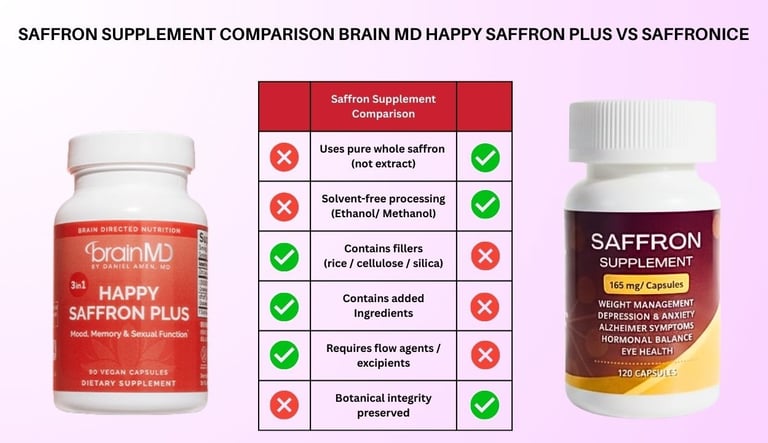
Saffron supplement labels often use similar terms for very different products. Understanding words like “extract,” “standardised,” and “other ingredients” helps clarify what a capsule actually contains.
Introduction: Why Labels Can Be Misleading
Two saffron supplements can appear almost identical on the front of the bottle — yet be entirely different in composition.
This confusion usually comes from:
Ambiguous wording
Emphasis on highlighted terms
Ingredient lists that require interpretation
Learning how to read a saffron supplement label removes guesswork and allows informed decisions based on what is actually in the capsule, not how it is presented.
Start With the Ingredient List (Not the Front Label)
The most important information is not the product name or headline claims — it is the ingredient list.
Look for:
Whether saffron is listed as powder, extract, or part of a blend
The number of non-saffron ingredients
The order in which ingredients appear
Ingredients are typically listed by weight, from highest to lowest.
“Saffron” vs “Saffron Extract” on Labels
These terms are not interchangeable.
If the label says:
Saffron powder or saffron stigma
→ This usually indicates whole saffron.Saffron extract
→ This indicates a processed ingredient, not the whole plant.
Even if both products reference saffron, they represent different materials.
Understanding “Standardised” Claims
If a label mentions that saffron is “standardised,” it means:
The ingredient has been adjusted to meet a fixed specification
The natural variation of the plant has been altered
Only selected components are being measured
Standardisation reflects manufacturing control, not botanical completeness.
The “Other Ingredients” Section
This section often reveals more than the main ingredient list.
Common entries include:
Cellulose
Rice flour
Silicon dioxide
Magnesium stearate
These are not active saffron components.
They are included to support capsule filling and powder behaviour.
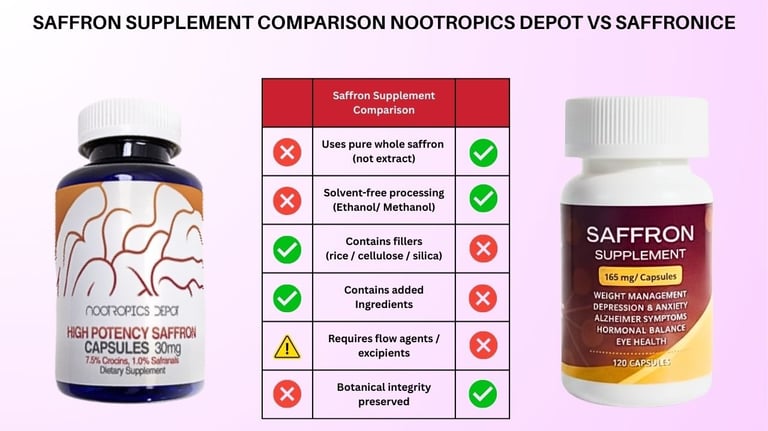
Why Capsule Size Can Be Misleading
Large capsules do not necessarily contain more saffron.
In many cases:
Extracts occupy very little space
Fillers are added to increase capsule volume
The visual size of the capsule does not reflect saffron content
This is why ingredient ratios matter more than appearance.
Single-Ingredient vs Multi-Ingredient Labels
A single-ingredient label usually lists:
Saffron (powdered stigma)
A multi-ingredient label may list:
Saffron extract
Fillers
Flow agents
Additional plant extracts or nutrients
Neither format is inherently wrong — but they represent different formulation choices.
What Labels Usually Do Not Explain
Most labels do not clearly state:
How saffron was processed
Whether solvents were used
Why fillers are required
How much of the capsule is non-saffron material
This is why understanding terminology matters.
Red Flags vs Neutral Indicators
Neutral indicators:
Clear ingredient naming
Short ingredient lists
Transparent use of terms like “powder” or “extract”
Potential red flags:
Long ingredient lists without explanation
Vague wording such as “proprietary blend”
Emphasis on numbers without context
The goal is clarity, not suspicion.
Connecting Label Reading to the Bigger Picture
This page completes the framework explained in:
👉 Pure Saffron vs Saffron Extracts: What Most Supplements Don’t Explain
It also ties directly to:
Together, these pages form a complete educational resource.

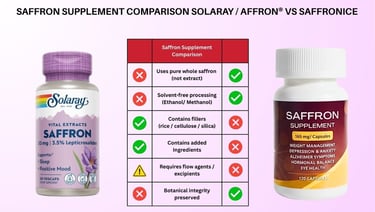
Key Takeaway
A saffron supplement label does not always mean what it appears to mean.
Understanding the difference between whole saffron, extracts, standardisation, and added ingredients allows readers to interpret labels accurately — without relying on marketing language.
FAQ
Where should I look first on a supplement label?
The ingredient list provides the clearest information about what the product contains.
Does “saffron extract” mean the same as saffron powder?
No. Extracts are processed ingredients and do not contain the whole plant.
Why do some labels list many extra ingredients?
Additional ingredients are often included to support manufacturing and capsule filling.
Does capsule size reflect saffron content?
No. Capsule size can be influenced by fillers and does not reliably indicate saffron quantity.
Is a shorter ingredient list better?
Shorter ingredient lists generally indicate less processing and fewer added substances.
Can labels be technically correct but still confusing?
Yes. Labels may be accurate but still unclear without understanding formulation terminology.

Address
34 Camelia Ave,
Logan Central, QLD 4114
Contacts
+61 410 343 678
hello@saffronco.com.au
All rights reserved @2025 Saffron Co.